Mold Surface Texturing: A Physical Alternative to PTFE

The gradual ban on PFAS is pushing manufacturers to find reliable alternatives to these persistent pollutants. As an innovative healthcare plastics player, Clayens is fully committed to this shift by developing additive-free solutions that are high-performing, durable and safe.
Clayens' surface functionalization technology is based on direct texturing of injection mold cavities using micro- and nanoscale patterns. These patterns engraved in the tooling are then perfectly replicated on each injected plastic part, giving surfaces new functional properties (hydrophobicity, anti-friction, antibacterial effect, etc.) without chemical treatment or additives.
An ecological and cost-effective alternative
The goal of this new application is clear: to eliminate the use of fluorinated materials such as polytetrafluoroethylene (PTFE), or other lubricants commonly used to improve slip in technical plastics.
Not only do these substances pose environmental, regulatory and health risks, they are also costly. By replacing them with physical texturing integrated at manufacturing stage, Clayens offers a cleaner, long-term stable and economically advantageous solution by removing the extra cost of additive materials.
Rigorous hydrophobicity and slip tests
Tests were carried out on plaques injected in textured molds, along two distinct test axes: hydrophobicity and slip.
For hydrophobicity, the water droplet contact angle was measured on textured polyethylene (PE) surfaces, compared with PTFE surfaces.
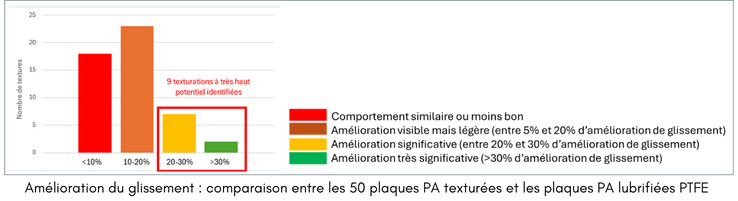
For slip, the test consisted of measuring the force required to set a standard polyamide (PA) surface (natural and non-textured) in motion compared with the surfaces under review:
- a "PTFE-lubricated" PA (PA compound loaded with PTFE used for various applications including medical)
- a textured PA (50 textures tested).
Protocols were designed to ensure reproducibility of laboratory results, with strictly identical friction conditions.
Significant results
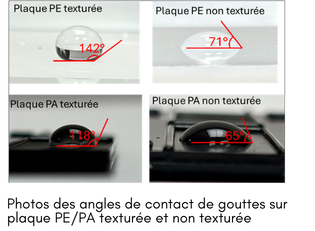
For hydrophobicity, textured surfaces reached a contact angle of 142° (compared with average contact angles between 110° and 126° for PTFE). This difference confirms the value of texturing for liquid repellency without added fluorine.
For slip, 9 of the 50 textures tested achieved at least a 20% reduction in friction force compared with the PA/PTFE configuration. Two of them even reached gains close to 40%.
An approach that is also economically advantageous
These results show that surface texturing can not only replace but outperform fluorinated solutions, with a 100% physical approach, no migration, and suitability for critical environments such as medical and food applications.
Moreover, because this solution can be replicated across many produced parts, Clayens says it enables substantial savings by avoiding the extra cost of PTFE-loaded materials, which can triple material price in some cases studied by the molder. The benefit can become considerable for large production runs.
Extending tests to new functional variables
"These results confirm the relevance of surface functionalization as a lever for sustainable innovation," says Matthieu Besse, Healthcare R&D Manager at Clayens Healthcare. "Not only do we eliminate controversial additives such as PTFE, but we achieve better performance with standard materials suited to our customers' regulatory constraints. These advances also open the way to new texture/material combinations, including with other technical polymers used in gears, pistons, valves and connectors."
Clayens is actively exploring opportunities offered by surface functionalization, with results already confirmed on several major axes: hydrophobicity and flow[1], anti-friction[2] and reduced bacterial adhesion[3].
Next steps will aim to extend testing to new materials.
About Clayens:
CLAYENS HEALTHCARE, the Healthcare division of the CLAYENS Group, supports healthcare industry players (medical devices, pharmaceuticals and diagnostics) in developing, industrializing and manufacturing custom medical devices and plastic components in compliance with international regulatory standards.
CLAYENS Healthcare offers a full service from R&D to production, including industrialization, qualification, validation and regulatory support.
Present in 9 countries, the CLAYENS Group has nearly 5,000 people and 32 manufacturing sites. The Group's 8 cleanrooms are located in France (ISO7), the United States (ISO8) and Mexico (ISO7).
Find out more: https://www.clayens.com/healthcare.
------
Contact us
+1 (347) 526-3019